
When 300 people are walking into your holiday party in nine days, the last thing you want to be doing is juggling six caterers, four spreadsheets, and a group chat full of dietary requests. That was exactly the spot Maya found herself in – and it is the spot most GTA office managers, HR leads, and executive assistants land in every December.
Here is how one downtown Toronto firm took its holiday party from spreadsheet chaos to a single, calm invoice – and what actually changed for the people running it.
The setup: a 300-guest holiday party and an inbox on fire
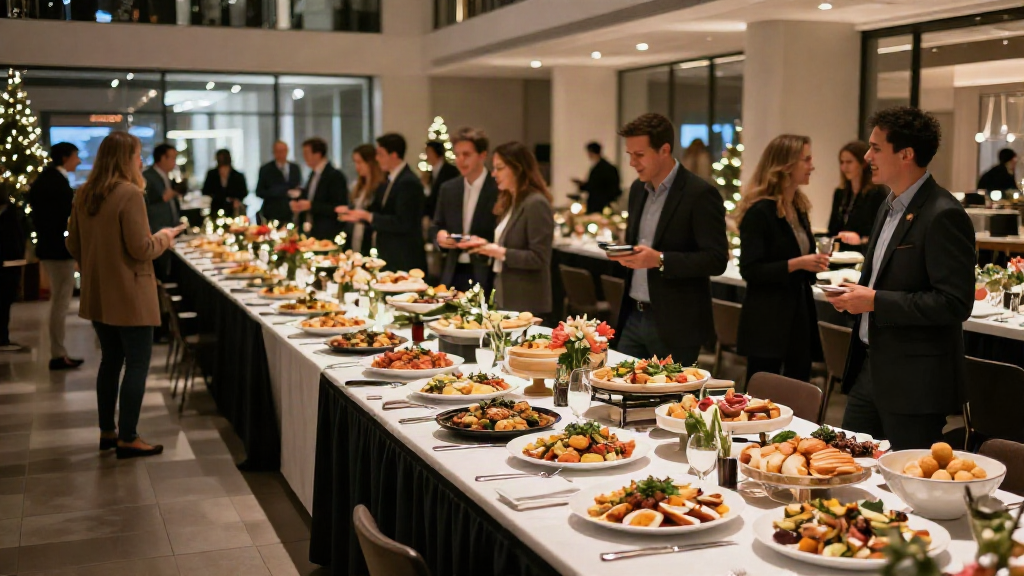
Maya runs workplace operations for a mid-size professional services firm in Toronto’s financial district. Her holiday party checklist looked reasonable on paper: one venue, one date, 300 guests, and a mandate from leadership to make it feel generous rather than corporate-cafeteria.
Then the details hit.
The guest count was a moving target. RSVPs drifted up and down by twenty people a day. The dietary spread was its own project – vegan, halal, gluten-free, two nut allergies, and a handful of “I’ll know closer to the date.” And nobody wanted a repeat of last year, when three separate vendors meant three arrival windows, three invoices, and a cold main course by 7pm.
“I had a spreadsheet for the spreadsheet,” Maya says. “Every caterer wanted a different format, a different deposit schedule, and a different person to chase.”
The real cost was not the food. It was the hours – roughly two working weeks of admin, spread across a stretch when Maya also had year-end reporting due.
The scramble: why holiday catering breaks at scale
Most offices do not struggle because they cannot find food. They struggle because holiday events stack every hard part of group ordering into a single afternoon.
- Multiple vendors, multiple formats. Each caterer quotes differently, so comparing is guesswork.
- Dietary coverage you cannot verify quickly. You need one view of who gets what without building it by hand.
- A guest count that never stops moving. Numbers that shift late break minimums, headcounts, and delivery logistics.
- Delivery windows that do not line up. Six arrival times means a load-in scramble and food that sits.
- Invoices that multiply. Finance wants one clean bill; you have five.
None of these are catering problems. They are coordination problems – and coordination is exactly where a platform beats a pile of email threads.
How the event got planned on one platform
Maya moved the whole party onto Food Mamba, and the plan collapsed from six moving parts into one.
Step 1: Match to vetted vendors. Instead of cold-calling caterers, she searched within a network of 350+ verified vendors across 63 cuisines. For a 300-guest Toronto holiday party, that meant real options for the menu, the budget, and the range of dietary needs – without a single reference call to vet a kitchen.
Step 2: Lock the menu on one approval. Menus, per-head pricing, and dietary tags lived in one place, so leadership could review and sign off on a single document. No re-quoting, no comparing PDFs from three caterers.
Step 3: Absorb the shifting headcount. The guest count settled into one order instead of being re-negotiated vendor by vendor. That flexibility is the difference between a party that bends and a party that breaks.
Step 4: Consolidate the delivery. One coordinated delivery and setup meant the food landed hot and on time – not in six waves across two hours.
Step 5: One invoice. Every item, every vendor, one bill. Finance closed it the same week.
“The part I did not expect was how quiet it got,” Maya says. “The week of the party, I had nothing to chase. The plan just ran.”
The results: admin time back, and a party people actually noticed
The firm fed 300 guests at its holiday party with a fraction of the admin time it spent the year before. The headline numbers the ops team tracked:
- Roughly 10 working days of admin reduced to a few hours of planning and approval.
- One vendor relationship and one invoice instead of six.
- Full dietary coverage confirmed before the event, with no last-minute substitutions.
But the number that mattered most was not on the spreadsheet. Guests noticed the food. Leadership noticed the calm. And Maya got to spend December on year-end work instead of chasing caterers.
“Nobody remembers that we used a platform. They remember that there was something for everyone and it showed up hot,” she says. “That is the whole job.”
What this means for your holiday party
If you are staring down a holiday office party in Toronto – or a recurring office lunch program that runs all year – the lesson scales. Group ordering at volume is a coordination problem, and coordination gets dramatically easier when the vendors, the menu, the headcount, the delivery, and the invoice all live in one place.
A few things to put in your own checklist:
- Start the platform, not the phone tree. Vetted vendors beat cold calls when you are short on time.
- Choose coverage over a single menu. Make sure vegan, halal, gluten-free, and allergy needs are visibly handled before you book.
- Keep the headcount flexible. A moving guest list should be a setting, not a crisis.
- Insist on one invoice. If finance has to reconcile five bills, you have not solved the problem.
- Rely on proof. 300+ offices, 350+ verified vendors, and 63 cuisines exist because this is a repeatable job, not a one-off favor.
The holiday party is supposed to be the fun part of December. On the Mamba way, you browse, order, and get back to your actual job – with the food handled and the invoice already clean.
Ready to plan your office holiday party without the spreadsheet chaos? Start your order and see what one platform can do for 300 guests.

Leave a Reply